





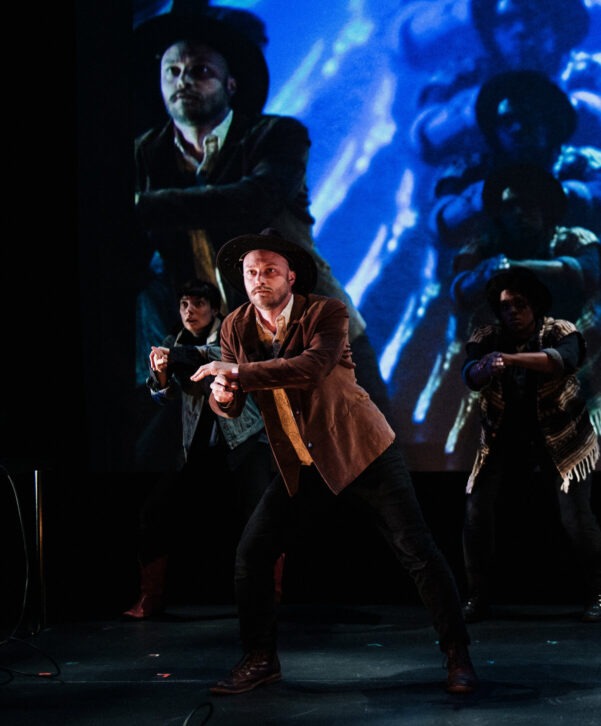
 It is often the case that when young people are given time, autonomy, and a safe environment, they are able to discover who they are, what inspires them, and what it is they want to do. At Wayfinder, we try to provide these opportunities that can be fundamental to a young person’s development. Andrew Murdock, a theatrical puppet and video artist, attests to this experience. At age eleven, Andrew started attending our predecessor camp, Adventure Game Theater, where he fell in love with crafting. His first camp was a “specialty camp” relic where campers made everything for the Adventure on site that week. Andrew picked the crafters group, making weapons and props for the game, and never left. One of our most prolific crafters, Andrew was an apprentice and staff for years teaching his skills to many of the crafters still working today.
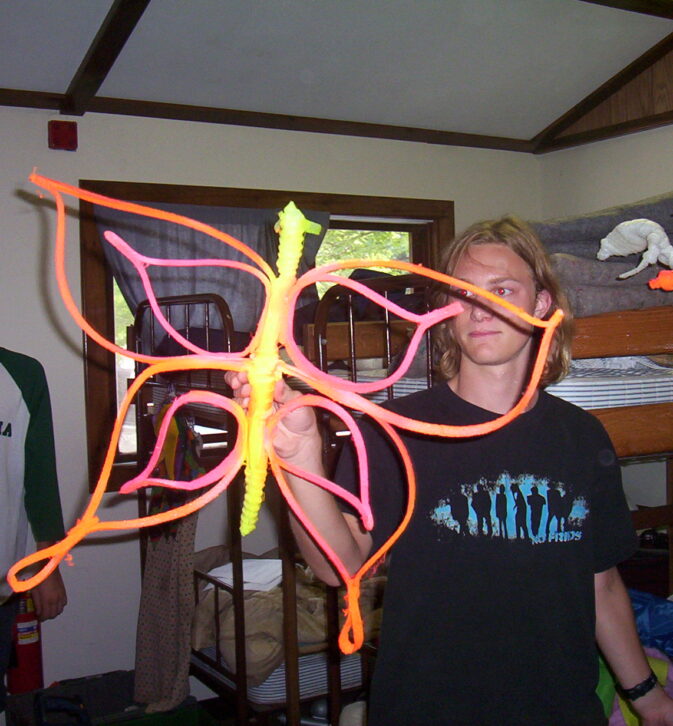
Andrew earned a masters from Sarah Lawrence and did undergrad at RISD, but credits Wayfinder for discovering what he wanted to study. “Wayfinder was my intro to collaborative art making, theater and improv.” As an apprentice, he was asked to make black light puppets out of crafting scraps, and they were so fun and whimsical that we still use them today. “We were making these lizards that you could move around with the rod. And then we were making jumping lizards. And then we made birds. And it was like, oh my God, this connects all the things that I love – engineering, sculpture, storytelling, performance, improv. And I was like, bam, this is it!” That is when the connection happened, but he had been making similar things since childhood for school projects. The difference was that, this time, he was working with a team with a very fast turnaround, teaching him another valuable skill. It was ”quick and dirty. I think it was an important lesson that everyone needs to learn, how to perform with very little, to build a set out of fabric and tea lights. And that I think is probably one of my greatest early lessons as a collaborative art maker.”
 As a free-lance artist and teacher, Andrew’s gigs bring him all around, performing in NYC, teaching college courses, and helping out at a local theater near his home in the Adirondacks, and he still uses this quick and dirty approach. “It’s an intro activity that I do in intro to making puppets because it’s always 50% making and 50% performing. I throw out a bunch of wire and tape and scraps of cardboard and make them make something very quickly by passing it around collaboratively.” Another way Wayfinder has influenced Andrew’s teaching style is teaching him how to meet people on their level. “In any sort of facilitated or creative class, you can’t force it. You have to meet people at their level, but you [as the teacher] need to take a chance and be goofy and fully commit to whatever the activity is, that is going to inspire that same thing in the participants.” He uses this approach because he believes “playing and experiencing are the greatest teaching tools. That’s how you actually learn.” He strives to make his classes a place for creativity to thrive. “I think what I gained from Wayfinder is that the process is the most important. It’s not about trying to get a result. It’s about inspiring creativity. And I think that that happens in almost every Wayfinder camp to some degree because it’s just about setting the stage, making sure everyone is heard, respected and listened to. And then once people feel like they are in a safe, loving, and nurturing community…, then creativity is the natural next step. Once everyone is committed to that experience, that’s where the magic happens.”
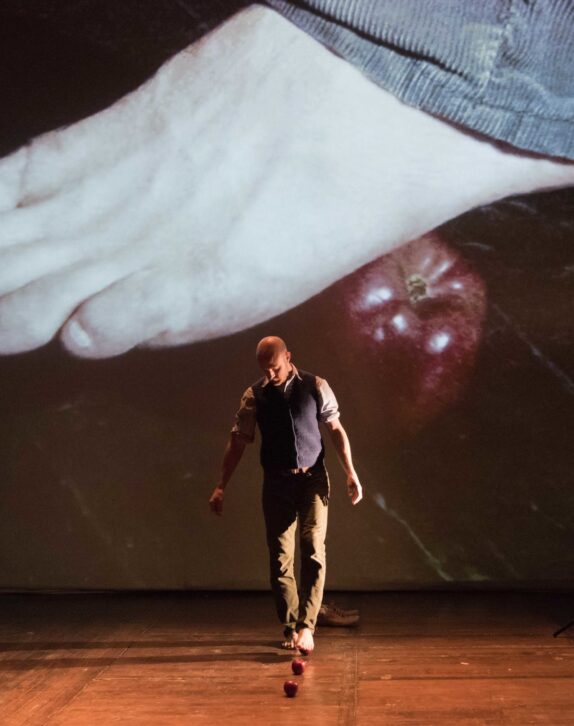 This magic – the ability to pretend, play, and take chances, and then by extension grow our understanding and empathy for others and the world – is something we all can find, but sometimes we need models of play and support to really access it. Andrew describes being an eleven year old, pulling up to camp for the first time, seeing the adults around him play: “I was like, ‘This is bananas.’ And also this is my dream, having a whole bunch of people play an elaborate game of pretend. Being a shy and awkward child and teen, the confidence you gain from pretending to be other people is so exciting. But the key is making the space as safe as possible for young people. Having that space held for you to be a nutcase or be a weirdo or be a goofball, to have that space for you to explore your identity through being other people, I feel is invaluable.”
P.S. Since the interview Andrew has become the studio art teacher at a progressive private school (4-9th) called the North Country School in Lake Placid, NY. Where he still uses many of the methods he learned from WFE to bond and activate creativity in his students. As well as helping them run their annual LARP event- which was inspired by a previous Wayfinder program done at the school many years ago.
You can find Andrew at his website, andrewmurdock.com, and on Instagram, @amurdock_projects. His next performance is this summer at: https://www.upperjayartcenter.org/events/beacon-theatre-puppetry-1
Written by Trine Boode-Petersen, Edited by Matt Nusbaum from an interview in 2024